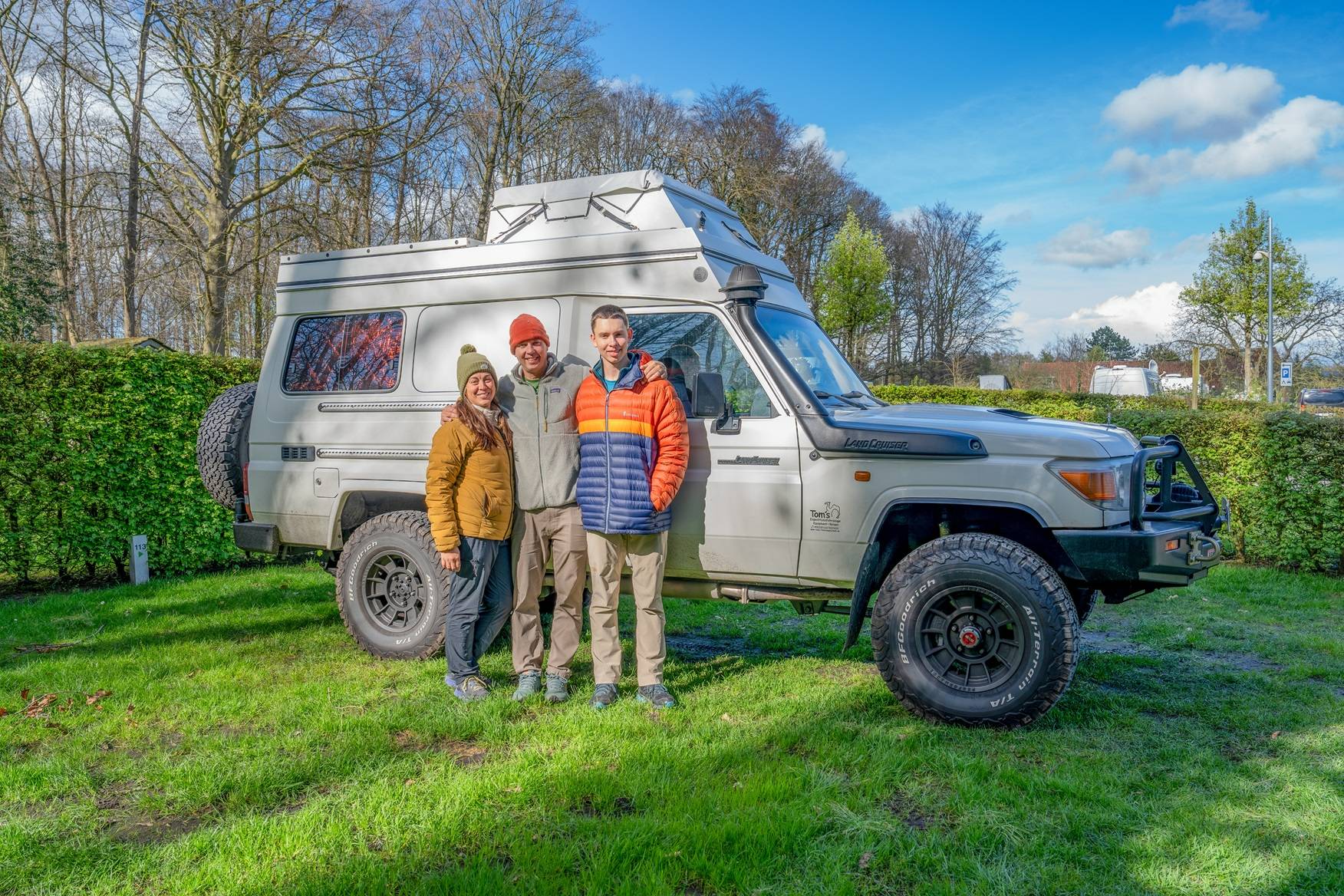

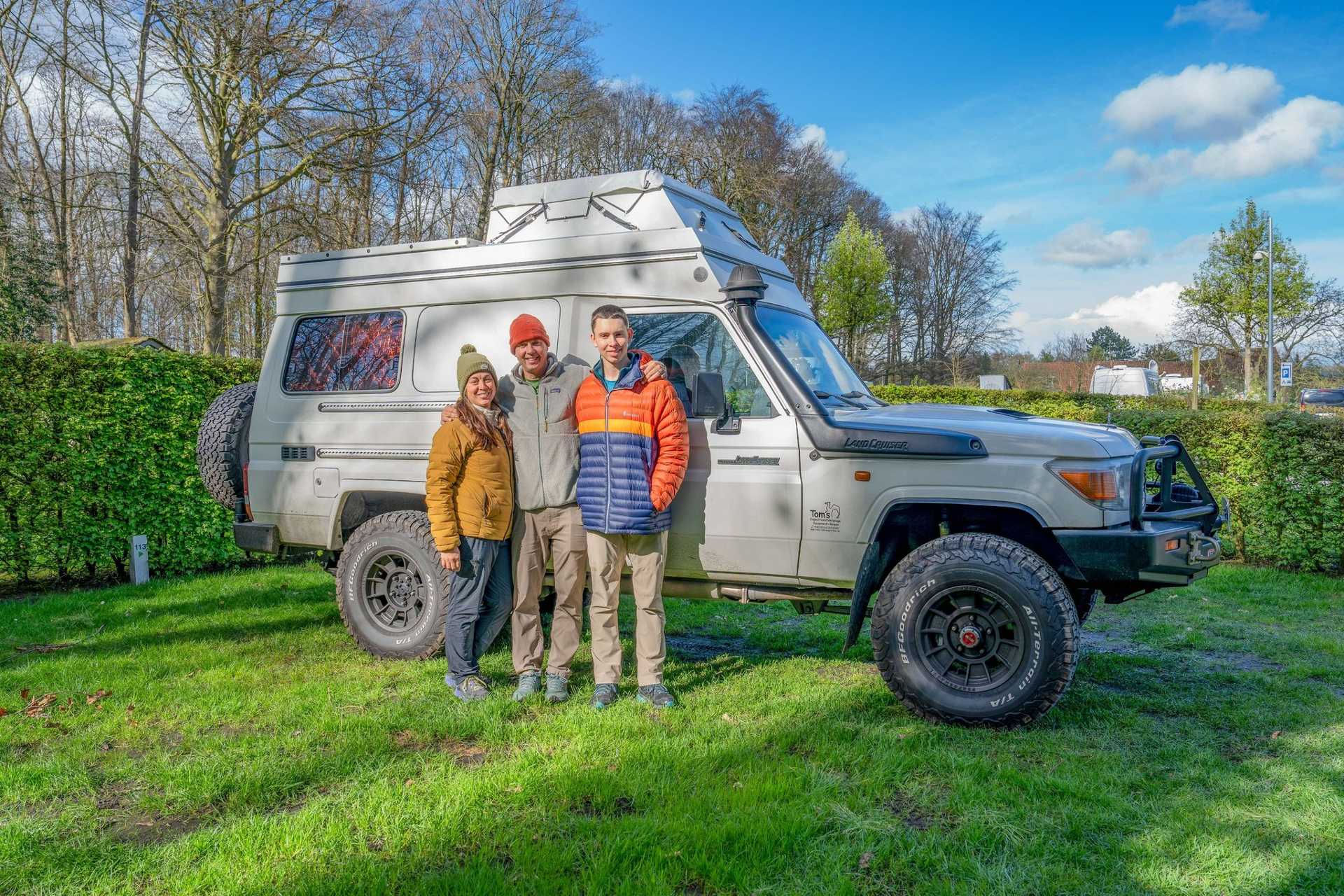

While Ambulicious (The ambulance we converted and lived in for our first year of travel) and Dusty the Mudslinger (Our Landcruiser 100 series with a rooftop tent) served us well for the last 7 years on the road, we always knew that they wouldn’t be our forever vehicles. The way we travel evolves as we embark on each leg of our journey. We’ve found that road-weariness is a real thing and traveling with a dog and a teenager who is taller than both of his parents has created somewhat of a space issue as far as sleeping arrangements go. We figured that once we had Dusty the Mudslinger, it would take us from the USA all the way down to Ushuaia and back up to Uruguay where we’d eventually sell it and buy another vehicle for Africa and beyond. We figured that wouldn’t happen until at least 2027. But all the stars aligned and our dream expedition vehicle popped up on Expeditionmeister just as we were about to head to the Galapagos Islands for Christmas, 2023.
We initially wanted a diesel LandCruiser 78 Troop Carrier since before we left the US, but at that time we couldn’t import one to the US. Since then, we have been keeping our eye out for out next vehicle for Africa. Kaden had been looking online when all of a sudden, there it was. A low mile Troopy built by a reputable outfitter within our price range. We looked at each other and said, “Do we do it?” We instantly knew the daunting procedures ahead of us if we decided to purchase this vehicle and still said “Yes!” We instantly called the seller and advised we were interested in buying the vehicle. He advised that he literally listed the vehicle less than 30 minutes prior to our call. He said that he had previously offered it to another person over 6 months ago and when it became clear that they weren’t going to be able to make the purchase, he re-listed the vehicle.
We explained that we would be in the Galapagos for a few weeks and would fly out to check out the vehicle and purchase it if it suited our needs. He advised that he was also going on vacation so the timing would be perfect. We bought plane tickets that evening and sent over the confirmation to prove we were serious.
Two days after we returned to mainland Ecuador from our Galapagos side trip, part of the country went to shit. There was a hostage situation where the local cartels took the news media hostage on live television, they kidnapped police officers and beheaded them on national television. It was horrible to watch as it all unfolded. In response, the president declared a state of emergency with a curfew in place and shut down all operations at the ports of entry and we were afraid that they were going to ground all flights and we would be stuck. Nobody in, nobody out. The president ordered the police and military to shoot on sight any cartel or suspected cartel member. We happened to be out driving with a friend who was letting us store Dusty the Mudslinger on his property while we were away when we heard all of this on the radio.
I couldn’t believe what I was hearing and I asked our friend if I was interpreting it correctly. He confirmed my suspicion. Then his phone started ringing. Incessantly. His friends and family were wondering where he was, if he was safe and told him to turn on the news radio. Where we were in Quito, it appeared to be business as usual. The owner of the hostel we were staying at called me numerous times to make sure we were safe and begged us to return to the hostel as soon as possible. Everyone in the country had been put on edge and were terrified. As Americans who deal with shootings and other violent crime on practically a daily basis, this didn’t scare us. Isn’t that sad? These things were happening in other parts of the country. Comparatively, it would be like traveling through San Francisco, but the hostage situation is in Los Angeles, so we weren’t scared. But things like this are so unheard of in most of these other nations we’ve been in, that the people just can’t imagine this type of violence.
The streets were empty and during the day and it seemed that only the police and military were out. Many businesses remained closed, taxi’s were few and far between and public transport ran, but on a reduced schedule. It was pretty surreal. Prior to any of this, we had been warned that there was an issue in the Las Esmeraldas area of Ecuador and that it was unsafe for locals and tourists alike and to avoid that region. Learning from past mistakes, we heeded their warnings and did not attempt to go there during our three months in Ecuador.
The following morning, our host at the hostel called for a taxi to take us to the airport. It was eerily quiet on the road, but when we arrived at the airport, it was bustling with people. Many of them were tourists, frantically trying to flee. The borders coming into Ecuador from Colombia and Peru were all closed with a high military presence. Anyone that was traveling like we do, were denied entry to Ecuador or given 5-10 days to get to the border of the neighboring country, depending on your mode of transportation (there are bike-packers that are riding bicycles down the Pan-American Highway).
We ended up catching our flight without any problems or hiccups. Everything was running smoothly and on time. You would never know that anything was amiss by the way the airport was operating. Business as usual.
We arrived in the UK at Heathrow airport and had to make our way out past Bristol to a little town called Yorkley, in the Forest of Dean. Which is NOT serviced by public transportation beyond Lydney. So, we took a bus from the airport to Bristol, changed to the train in Bristol to Cardiff where we got another bus from Cardiff to Lydney and a taxi from Lydney to Yorkley. It was a VERY long two days of travel.
We met with the seller, looked over the vehicle, test drove it, took it to a mechanic to have it inspected and found just a couple of minor issues that needed to be taken care of, which the seller disclosed previously. A couple of days later, we had bought the vehicle and now we needed to figure out how to register it and get the title (V5C in UK), and insure it. This was not easy. In fact it was difficult enough that I’ll never buy another vehicle in the UK and this is why…
As a foreigner you can purchase any vehicle you want in the UK. But you need an address to register it unless you have a place you’re permanently exporting to. This vehicle doesn’t meet any euro emissions standards and since Brexit, exporting UK vehicles has become costly. UK vehicles are made very specifically for safety standards in the UK, they drive on the right side of the vehicle and the left side of the road, so if your vehicle is made for the UK, you have to modify it to be driven outside of the UK. This vehicle is a left hand drive because it was originally made for the Dubai market and exported to the UK. Registering the vehicle was not an issue for us because we have a good friend who lives in Bristol and has graciously agreed to allow us to use her residence for our vehicle registration.
The next problem was finding insurance. As a foreigner without a UK driving license, many insurance companies charge outrageous prices because you have no driving record. One of them quoted us £17,000.00 for the year. Yes, Seventeen thousand pounds, which is over $20,000.00 USD. The next problem we had was finding an insurance company who COULD insure the vehicle. Because it’s modified as an expedition vehicle, but still registered as a light duty personal vehicle that exceeds the weight limit most insurance companies wouldn’t insure it as a foreigner, but wouldn’t be a problem if we were residents. We found ONE company that would insure it, but the cost was £2,000.00 for 6 months. We didn’t have a choice. It was either that or we just spent a bunch of money on a vehicle we couldn’t drive. We waited four days to get our title (V5C) in the mail. The next thing we needed to do was to tax the vehicle, which in the US, would be like registering it with the DMV, paying your licensing fees. This was easy enough, we just went online with the new V5C we received and were able to register it without a problem. It was about £300.00 for the year. Then we had to get the inspection, which is an annual thing. It’s different than a smog check. In the US depending on where you live, you need a smog check to register your vehicle. In the UK, they have what they call the MOT. It is an overall safety inspection of your vehicle including emissions. So they check that your seat belts work, the hazard lights and turn signals work, the AC and heater function, they check the windscreen for chips and cracks and report anything that is unsafe to the DVLA (DMV in the US) then they issue you a certificate of pass or fail. If you fail, they show you all the things that need to be fixed to make it road worthy. This has to be done annually and can only be done in the UK. The UK does not allow for the vehicle to be out of the country for more than 12 months without permanently exporting it to another country. This vehicle does not meet US safety or emissions standards even though it meets the safety standards for the UK which is a higher standard than the US, which means we’ll have to wait until the vehicle is 25 years old to import it permanently to the US. Which means we have to wait until 2038 to import it back to the US.
We have already tried to import it to Spain, where we’re currently “living” and have gained residency, but the vehicle is too modified for them to allow importation since the vehicle is registered in the UK and we aren’t UK residents or citizens, even with a Certificate of Conformity. So we’re kind of stuck. This is part of living in the “gray area” like we do. There is no rule book to follow.
Once we purchased Sid, we had to fly back to Ecuador and figure out how to sell Dusty the Mudslinger. This meant finding a place to store Sid until we could get back to the UK. We originally wanted to ship Sid back to South America and continue our trip south, but the Red Sea was in crisis with the launching of missiles and armed drones at Israel in response to the war in Gaza. The Panama Canal was suffering a severe drought and ships were being diverted around the tip of South America and Oil prices spiked making shipping costs nearly triple. The $4,000 – $5,000 shipping cost was approaching the $12-16k for the same route and the crossing went from 40 days to almost 90 days. It just didn’t make sense financially.
We stored Sid at the same place we picked it up. What we didn’t realize was that there is no reliable public transportation out there and there is no rideshare service. Cellular service is non-existent, people still use landlines out there. We walked a mile to a local pub to see if we could get a cab from there or wifi to find a bus schedule, but there was no wifi and the people there laughed at the thought of the bus. They told us that the bus might come today, if there was someone that was needing to be dropped off there. They started trying to help us, calling different cab companies which all said they don’t service the area anymore.
It had been cold and rainy and the walk to the nearest place to catch a bus was in the next town 7 miles away. After spending a couple of hours sharing stories with the locals in the pub, an older man in his 60’s offered us a ride to the main bus terminal in the next town. We just had to wait a few hours. So we did. He just happened to be celebrating his birthday and had offered for us to come celebrate with him as he was going pub crawling with some friends. We politely declined as we had to get back to London to catch our flight back to Ecuador the following day.
When we were boarding our flight back to Ecuador, Bronson and Kaden were in a different line than I was and I was asked to show proof of onward travel. They weren’t. I didn’t have proof of onward travel because we are driving our way down to the southern tip of the continent. I explained it to them multiple times and while Bronson and Kaden were waiting for me on the causeway, the lady was still giving me a hard time until I said told her that my family was standing there waiting for me and they made it through without proof of onward travel. Then the supervisor came over and told the woman to let me through and said “if you get turned away at the airport, it’s not our fault.” I told them not to worry, I’d take care of it. Just keep in mind, Ecuador was still in a state of crisis at the time. We’d only been gone two weeks and it’s very possible that I could have been turned away upon arrival. But we have tricks up our sleeve. When we landed, I showed the immigration and customs people our vehicle paperwork and explained our situation, they had no problem letting us through even without “proof of onward travel.”
Now we just needed to sell our other vehicle… We put some feelers out there in the overland community online and we got a lot of people who were interested in buying- in Colombia and Argentina. One of our friends, Juan from @overlandsally in Colombia told us that he had a few people that were interested in buying Dusty.
We made the trip back to Colombia, rented an apartment for a month while we got the vehicle inspected and fixed. Juan helped handle all of the paperwork, including getting a power of attorney to change the import permit. We had to go to a notary to get a legal document saying we’re selling the vehicle and transferring the title and registration so they could transfer the import permit to the new owner. The funny thing is, we sold the vehicle to a UK diplomat on assignment in Colombia.
The money transfer for the sale of Dusty didn’t go well. The buyer transferred money, but it somehow got lost in the bank upon conversion from the British pound to the US dollar. We spent 3 weeks tracking down the payment and in the meantime, had already made our way back to the UK to pick up Sid. The buyer showed proof of payment, but it was lost between banks somewhere. Long story short, we met the diplomat in the UK, went to his bank, who couldn’t track down the money, called our bank, who couldn’t track down the money because it had never made it to our bank. Called back to his bank who was able to show where the money went, called that bank where the money went and turned out they still had the money, which they then sent the money back to the buyer who had initiated another transfer by phone while waiting on this money to come back to his account. The money was showing pending in our account the next day, but not accessible.
Dealing with the money transfer was stressful and would have been unnecessary if the US system was more streamlined. Most of the rest of the world doesn’t use the SWIFT banking system that the US does because it’s antiquated and takes a long time for money to convert, transfer and fund. You’re looking at three to ten days for money to be available to you in the US. All around the world, with any other banking system, the money is transferred and funded into your account within hours unless it’s a holiday, then it would fund the next business day. Not to mention, there are subsidiaries who have to receive the money, then send the money to be converted to the local currency, then sent back to the bank of origination, then sent from there to your account, then the checks and balances to make sure the money is legit, even though they’ve sent CASH.
Overall, it’s a nightmare to be avoided for sure. I would probably never do it again unless I could immediately import it to my “place of residence” wherever that happens to be for the time being. At least all this is behind us now and we’ve finally secured our permanent expedition vehicle for global travel. Well, permanent for now. Who knows what the future holds?